


Mastering the Machine: How to Talk to AI and Actually Get the Answers You Want

Artificial intelligence has officially crossed the threshold from high-tech novelty to an indispensable daily sidekick. From drafting late-night emails to solving complex code bugs, millions of users prompt language models every single minute. Yet, a universal frustration lingers in offices and home desks worldwide: why does the AI output sometimes feel so generic, confusing, or completely off the mark?
The short answer is surprisingly simple: an artificial intelligence is only as brilliant as the instructions it receives. Generative models do not possess mind-reading capabilities; they rely entirely on pattern recognition and contextual clues. When you offer a vague request, you force the algorithm to guess your intentions, which inevitably leads to lukewarm, robotic responses. Learning the art of prompt engineering is no longer a niche skill for software developers; it is the ultimate productivity hack for everyday internet users.
The Myth of the Magic Single Sentence
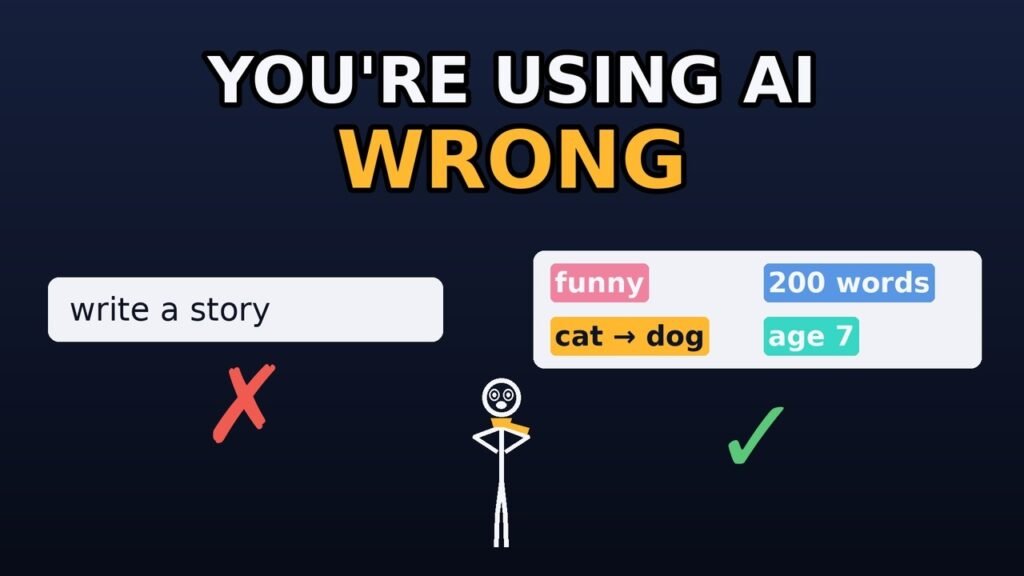
Most beginners treat AI interfaces like a standard Google search bar, typing short fragments such as “write a business plan” or “explain quantum physics.” While traditional search engines thrive on keywords to fetch indexed pages, generative AI requires rich context to build customized responses from scratch. A single-sentence prompt leaves vast blank spaces that the model fills with predictable, generic assumptions.
To eliminate fluff and secure precise results, you must transform your prompts into structured, highly descriptive instructions. Think of the AI as a newly hired, brilliantly smart assistant who possesses infinite facts but zero knowledge of your company’s internal culture. If you do not spell out your exact standards, format preferences, and end goals, the results will naturally fall short.
The Core Anatomy of a High-Accuracy Prompt
Creating a prompt that yields exceptional results does not require a degree in computer science, but it does demand a deliberate structure. Expert prompt creators systematically include four vital components in their instructions: Role, Task, Context, and Constraints. When these four pillars align, the model’s accuracy shifts dramatically from average to astonishing.
Role (Persona): Assigning a specific role forces the model to adopt a particular perspective, tone, and vocabulary depth. Asking the AI to “act as a senior financial advisor with 20 years of Wall Street experience” instantly shifts its internal weighting toward authoritative, professional language.
Task: State your primary request using explicit, action-oriented verbs. Instead of saying “I need help with my resume,” write “rewrite the work experience section of my resume to emphasize measurable leadership achievements.”
Context: Supply background details that ground the response in your real-world situation. Mention your target audience, the purpose of the document, or any relevant background history that shapes the outcome.
Constraints: Establish clear boundaries regarding length, tone, formatting, and structural preferences. Explicitly list what the AI must include—such as bullet points or tables—and what it must strictly avoid, such as jargon or conversational introductions.
Stop Asking, Start Feeding Examples
One of the most effective strategies for boosting precision is a technique known as few-shot prompting. Rather than relying solely on descriptive guidelines, provide one or two tangible examples of the exact style or structure you expect. Giving the model a clear blueprint eliminates ambiguity faster than paragraphs of standard explanation.
For instance, if you want the AI to write product descriptions for an e-commerce catalog, paste an existing description that performed exceptionally well. Instruct the model to analyze its tone, rhythm, and structural flow, then ask it to mimic that blueprint for a brand-new inventory item. The accuracy of the generated draft will instantly soar.
The Power of Iterative Conversation
Many users make the critical mistake of abandoning a prompt thread after a single unsatisfactory attempt. Generative AI interfaces are built for ongoing, iterative dialogue, meaning your initial prompt is merely the opening move of a collaborative process. If the first output misses the mark, do not discard the session; guide the model toward the target.
Respond directly to the output with specific feedback on what needs adjustments. Ask the system to tighten the word count, adjust the emotional tone, or expand on a specific bullet point. Treating the interaction as a constructive edit session allows you to refine the result until it matches your exact vision.
Forcing Internal Reasoning Before Answers
When dealing with logical reasoning, complex arithmetic, or multi-step analysis, AI models sometimes jump to conclusions prematurely. You can dramatically improve accuracy by instructing the AI to “think step-by-step” before providing its final answer. This strategy forces the algorithm to generate an internal chain of logic, reducing errors significantly.
By breaking complex problems down into sequential stages, the model processes each component systematically. Whether you are solving a tricky mathematical equation or analyzing a multi-layered legal contract, requesting a transparent, step-by-step walkthrough acts as an automatic quality check for the final response.
Setting Up Guardrails and Negative Constraints
Knowing what to exclude is just as crucial as specifying what to include in your request. Unguided language models frequently slip into repetitive filler phrases, hyperbole, or overly enthusiastic fluff. Adding negative constraints prevents these bad habits from creeping into your finalized text.
Include explicit guardrails in your prompt, such as “do not use passive voice,” “avoid corporate buzzwords,” or “do not include generic introductory sentences.” Establishing strict boundaries keeps the output focused, professional, and directly tailored to your practical needs.
Elevate Your Everyday Workflow Today
Mastering prompt construction completely redefines how you interact with artificial intelligence, converting a simple chatbot into a high-powered engine for productivity. By defining clear roles, providing rich context, setting firm constraints, and iterating through conversational feedback, you take total command of the output. The power of modern AI lies not within the algorithm itself, but in the clarity of the voice guiding it.